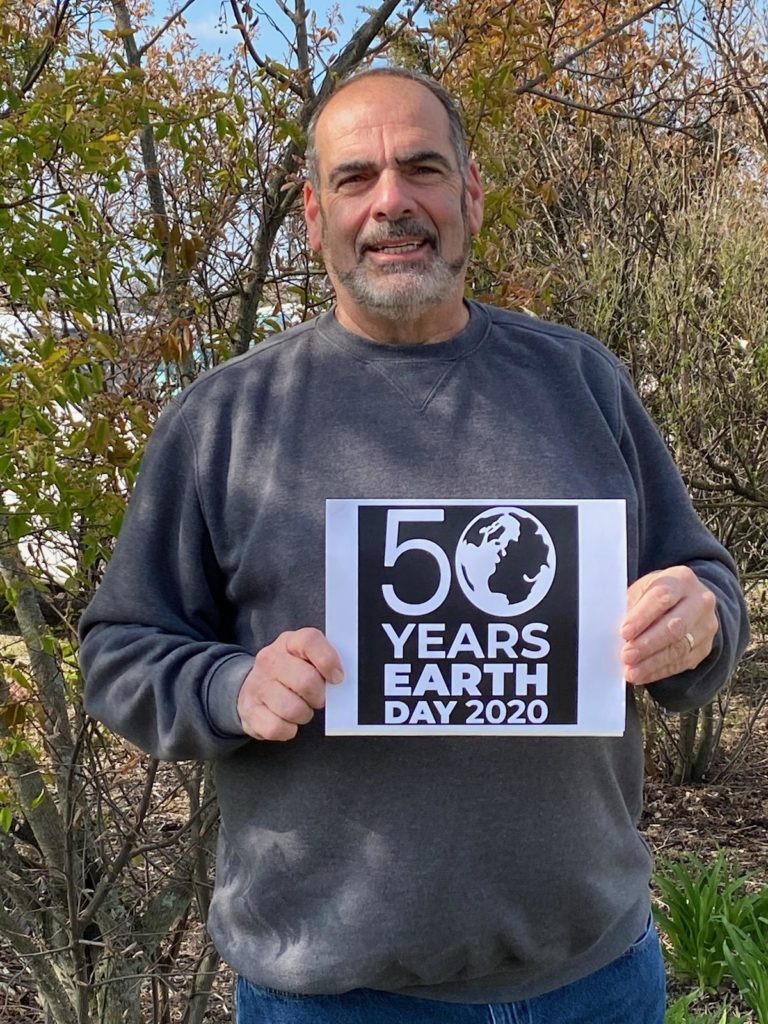
The NJSEA’s Gaby Bennett-Meany sent in the following Earth Day message:
The very first Earth Day was celebrated on April 22, 1970, with more than 20 million Americans taking to the outdoors demonstrating the need for environmental reform. The rallies were a huge success with speeches focused on pollution air quality, water quality, natural resources, waste, and endangered and threatened species. Earth Day is recognized as a national holiday and celebrated in every community.
Although the “50th Anniversary of Earth Day” was scheduled with huge celebrations everywhere it will still be recognized globally in a unique, digital delight. Take the time to search for the digital celebrations on TV and online and absorb all that our planet has to offer. Go to www.earthday.org, the official Earth Day site which will bring you events and more all day tomorrow.
The 50th Anniversary of Earth Day will be a new beginning as we all join together in years to come as a new generation of environmentalist activists that will focus on sustainable initiatives and local and global action.
Celebrating the 50th Anniversary of Earth Day will be a new beginning and hopefully encourage us to desire a healthier place to live while prompting the small changes that everyone can make that together will have a far-reaching local and global effect on our planet.
As the country joins together to save lives and put an end to the worst health catastrophe of our time and desperately searches for ways to try to be sure it never happens again, we need to also at the same time recognize the need to come together as part of the very same battle for the long term health of all of us by saving and protecting our environment – not only for our generation but also for the health of future generations to come.
Even as the Federal government sadly attempts to loosen environmental standards and, as understandably, our priorities are focused on fighting this insidious disease, we can and should be fighting to improve our environment. In fact, this may be the best chance we have had in generations to help our environment and make giant steps forward to improve the world for all of us for many years to come.
Now some folks may believe we can’t be sidetracked, that every bit of our efforts need to focus on the battle ahead, and that the environmental issues should be put on the back burner in favor of big business or for just another day.
But just for a minute let’s go back to another, even more desperate time in our history, when the battle to pass the Migratory Bird Treaty Act of 1918 was in the national spotlight. This landmark law that is now under attack continues to save countless birds, from the backyard Cardinal to the Peregrine Falcon. The events that occurred in our history at the time when the struggle to pass that law was being fought may surprise you.
The Migratory Bird Treaty Act was passed in an era when many bird species were threatened with extinction by the commercial trade in birds and bird feathers. The groundbreaking statute makes it unlawful without a waiver to pursue, hunt, take, capture, kill, or sell birds listed therein as migratory birds.
And yet as that law was being fought for, the United States was in the depths of World War I and the Spanish Flu epidemic and despite the tragic and historic losses of millions of lives we still thought it was important enough to stand up and protect our bird life before it was too late. After all, even then we knew that where birds thrive so do people.
This is not the time to take a step back and say the environment can wait for another day. Our time is now more than ever to fight climate change which allows more disease to threaten human life, not only wildlife. Making sure our air gets cleaner and stays that way is imperative not only for the natural world but for example preventing future cases and protecting people with asthma especially in inner cities where they are more prone and the most vulnerable from the effects of breathing dirty air. And I am sure that I don’t need to remind us all how important clean water is not only to wildlife but also to every one of us as in the atrocious cases of Flint, Michigan, and Newark, New Jersey.
The fight against climate change, protecting clean air and clean water, is all connected to protecting and preserving not only on own health but our natural areas and ecosystems as well. In the words of John Muir, “When one tugs at a single thing in nature, he finds it attached to the rest of the world.” That is more true now than ever.
Saving, preserving and protecting our environment are not only about protecting the birds and animals, it is in the end about protecting and preserving ourselves, humankind.
Whether it is working to stem the decline of pollinators or making sure toxic waste gets cleaned up entirely no matter where it is there should be no going backwards. We can only go forward, and creating a healthier habitat for us and wildlife is one and the same.
We cannot forget how much we needed our forests and fields when it seemed the world was coming apart for many of us and we will need to never let ourselves and especially our elected officials forget about how important having healthy food, water and healthy places for our families was at this time and always will be.
After every catastrophe America stood up and did better, and this should be no different. Starting now we will have a chance to improve many aspects of our society from health care to Government. A healthy environment is a fundamental right of everyone no matter where you live and it will be a good place to start to improve the lives of all of us as we heal and rebuild from such a devasting time in all of our lives.
I thought this might be the perfect time to discuss a subject very close to all our hearts. At a time when most of us are at home, contemplating our future and what is next for all of us there are some things that are forever and constant, and hold a place in our hearts no matter life will bring us.
Now one of the questions I get asked most often by friends, school children and even newspaper reporters is one that may seem harmlessly simple at first but at times can be a very, very complicated and a complex question to say the least. The question usually starts innocently enough for sure but then is presented almost as an attempt to throw me off, even stump me or confuse me. “So Don, what is your favorite bird?” they ask with a teasing big grin.
That can be a question that ranks right up there with, “What is the meaning of life” or “Why is it always that the line that I am standing on always moves the slowest?” As a very astute friend once pointed out to me, “picking your favorite bird is like trying to pick your favorite child; it just can’t be done because there are so many wonderful things about each one of them.” Those are wise words for the ages to be sure.
But sometimes I am pressed for an answer, especially when there is a cute little boy or girl looking up at me holding their breath, just waiting and waiting for my answer, which most people expect for some reason to be incredibly insightful and thought provoking.
Now I have to admit at times I feel pressure to say what people think I should say. After all the President of Bergen County Audubon Society must have at the very least the Bald Eagle as his favorite bird, or maybe a Peregrine Falcon, an Osprey or some regal looking bird that will make everyone nod their head in agreement. I apologize but favorite birds do not work that way.
My favorite bird tends to surprise many people. It’s a common bird, to some maybe not the most beautiful of birds. At times passed over as folks look for the rare, more exotic species. But as my close friends well know my favorite bird of all without hesitation is the Red-winged Blackbird.
The reaction of many people when I finally come clean seems to be a bit of puzzlement. Really? They ask like a deer in the headlights. Yes, really.
Growing up in the Meadowlands I have a special connection to the Red-wings. Since it is one of the first birds to return in spring migration we kids could not wait to see the very first one of the year. For we knew then that spring could not be far away.
As the years went by I would point out the Red-wings to my two boys as I drove them back and forth to school. We had fun trying to see who would see the first one singing from the top of the grasses. Now, leading nature walks in the Meadowlands I enjoy telling stories about those special very birds, what it was like growing up in the Meadowlands, and the passion and love that we all inherited having the privilege of being raised in such a very special place.
That is what favorite birds really are all about, ones that mean something very special and personal and touch our hearts and souls.
Favorite birds are the ones that bring back fond memories of friends and family. Favorite birds are not just simply something that is added to a page in a book, APP or computer and then left to itself and forgotten. They are birds that we will brag to our grandkids about, daydream about when we get too old to wander the trails that are only left to recollections.
Favorite birds live in our hearts and play a significant part of our lives. They are our memories, ones we recall with delight and at times with much examination and considerable contemplation. They recall special times in our lives not only about the birds themselves but also the people in our lives we enjoyed them with and the wild places we have all come to love.
Favorite birds are just that: Birds that have become part of our lives and stay in our hearts and become who we are and what we are truly about forever.
Please let me know what your favorite bird is and why it is special to you. You can email me at greatauk4@gmail.com
In just a few weeks we will be celebrating the 50th anniversary of the first Earth Day and in the words of the classic Joni Mitchell song we seemed to not know what we had till it was gone, or in this case at least denied access.
As Covid-19 devastated our communities and their usual destinations were forced to close, more and more people were drawn to our local nature areas and open spaces. Whether it was out of nowhere else to go or a kind of primal urge to turn back to nature, individuals and families alike turned out in big numbers at our local, county and State Parks.
Sadly, that desire to return to the natural world may have been its undoing as officials began closing all those special places that many of us have grown to love over the years and maybe, more importantly, more had just now discovered and quickly found a passion for places they never knew were even there. As a close friend expressed to me, just when we needed nature the most it closed up.
On this very special anniversary on which we will celebrate victories like the Clean Water Act, Clean Air Act and the Endangered Species Act we will also understandably be denied access to the places that are the results of those victories, the places we cherish and revel in.
Sadly and perhaps ironically part of the reason is human kind may have started the outbreak is by the crimes we still commit against nature like in this case the ghastly and inhuman way animals are sold and marketed. And before you say it didn’t start here, I don’t know anyone who thinks our commercial corporate farms and slaughterhouses although better are not going to win any humane awards, at least in my book .
As the special day approaches, separated from the places and in some cases the people we love, we should never forget this Earth Day, as it was a time we faced human devastation, sacrifice and heroism never seen in this generation. But perhaps we also have come to realize how important and how much we crave the wild places in our State and communities. I hope we can and will recall that we needed meadows not malls, running streams and trees not an amusement park, wildlife not warehouses.
This no doubt will be saddest and most difficult Earth Day of all but this also could be the time in our history when Earth Day has a new beginning and a new special meaning not for just a few but for all of us as we join together and realize our love for the environment and our love for each other is inseparable, and if we allow it to exist and flourish, nature will bring joy to our hearts and heal our souls, something we could all use right now
In compliance with State Executive Order 118, DeKorte Park in Lyndhurst, River Barge Park in Carlstadt and Mill Creek Marsh in Secaucus are closed until further notice. Thank you for your cooperation.
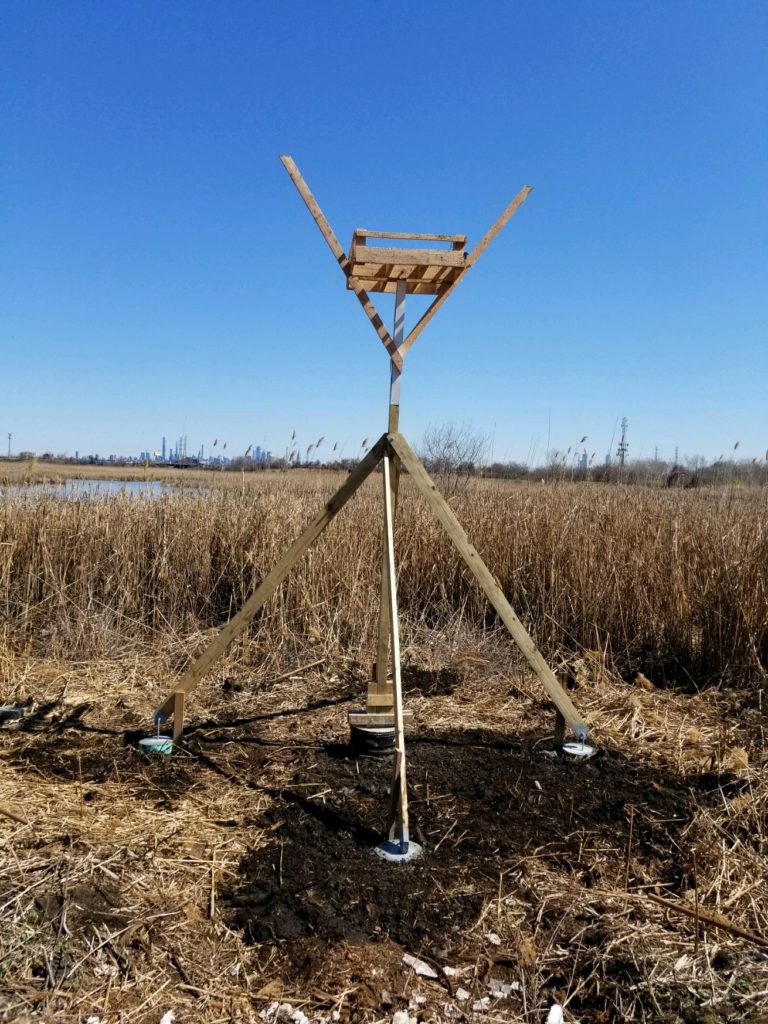
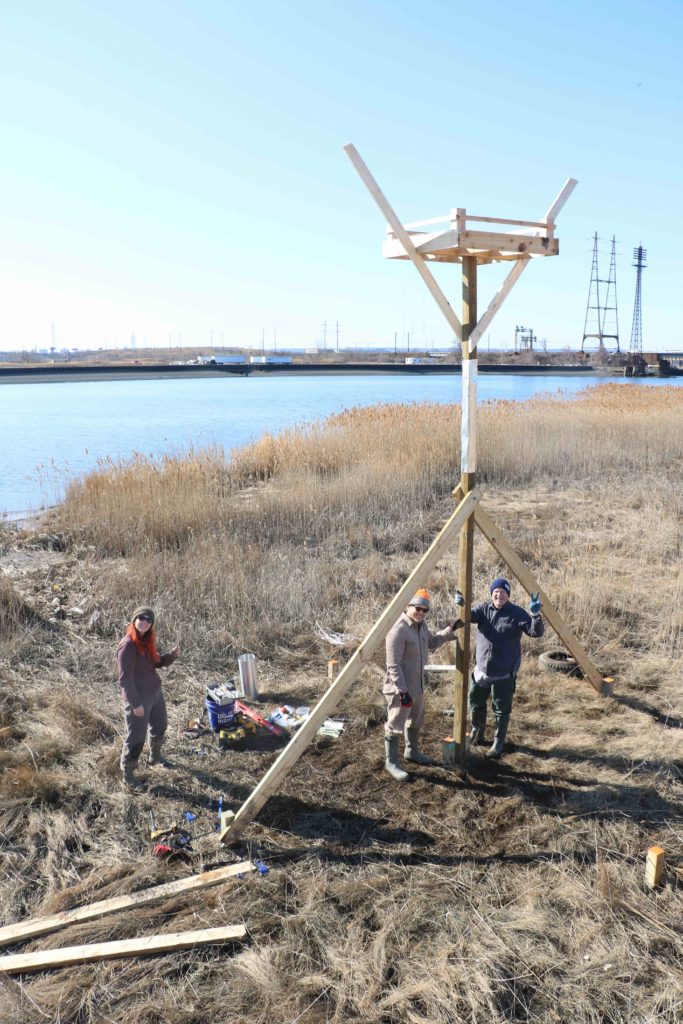
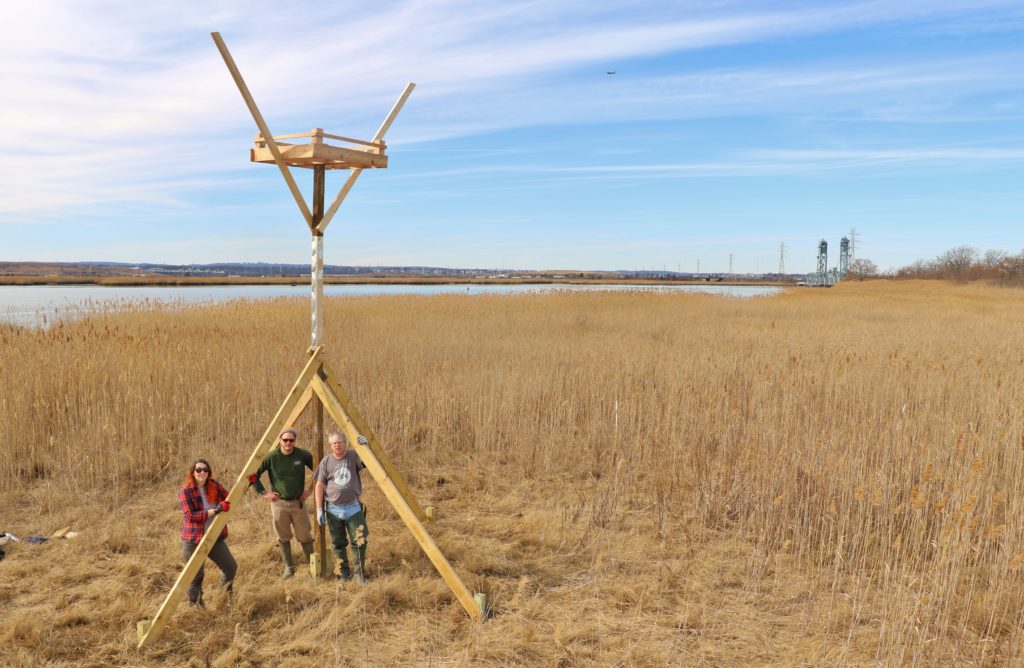
Our Osprey have arrived for the spring migration and are finding new nesting spots at several places in the Meadowlands as part of Operation Osprey Uplift. The multi-party collaboration by the NJSEA and its partners, which was spearheaded by the Bergen County Audubon Society, provides much-needed nesting space for the NJ Threatened Raptor.
Nest platforms have been installed in the past few months at the Erie Landfill in Lyndhurst, the 1E Landfill in North Arlington, the Keegan Landfill in Kearny, and at the River Bend and Hawk Marsh sites along the Hackensack River in Secaucus. While not pictured here, Osprey have been observed using the nest platforms.
Keegan Landfill, Kearny
The nest platforms and materials were donated by PSE&G and Joseph M. Sanzari, Inc. The Hackensack Riverkeeper assisted in the design of the platforms.
Operation Osprey Uplift team members also include the Bergen County Audubon Society, Meadowlands Conservation Trust and Conserve Wildlife Foundation.
River Bend, Secaucus
The Osprey population has made a remarkable resurgence in the region over the past four decades, to the point where Osprey in the Meadowlands outnumber suitable nesting locations. Operation Osprey Uplift is working to develop a variety of nesting approaches for the bird tailored to specific locations to assist in the continued resurgence of these majestic raptors.
Jim Wright’s new book, “The Real James Bond” (yes, there’s an ornotholigical thread) just got a great review in the Wall Street Journal! You can order it at amazon.com or publisher Schiffer Books, schifferbooks.com
Read the review here: https://www.realjamesbond.net/2020/04/the-wall-street-journal-review.html
Mickey Raine’s latest series of photos features this fantastic view taken at DeKorte from the park’s Kingsland Overlook looking down on Jill’s Garden in front of the Environment Center. Beautiful shots!
Song SparrowLenten RoseLenten RoseCardinalCardinal
Mickey Raine provides these great photos of the American Coot at DeKorte, plus a photogenic Tree Swallow and a Diamondback Terrapin, taken late last week. Thanks Mickey!
As old birders like to tell newcomers, no season is ever the same as the last, and as we are now all very much aware that could not be more true when it comes to all humankind this spring. But if there is any positive at all for birders and nature lovers to be spending more time at home it is that we will all be a firsthand witness to spring migration right in our own backyards. We’ll see how our little stand of trees and gardens is as much a wildlife habitat as any nature center or park.
Tree Swallow
Just as there is a housing shortage in the Garden State for people it is the same for most of our feathered friends. Anyone who has lived in New Jersey has witnessed firsthand the devastating loss of natural wildlife habitat right in our own neighborhoods. When many of us were growing up there was always a pond, a patch of woods or a grassy meadow that we loved to play in.
But take a look around your town now, where has it gone? It is now a shopping mall, a housing development or a parking lot. And now try to imagine if you are a bird returning to those places in the spring to nest. Where do you go? The good news is that we can give many bird species a helping hand by putting up nest boxes, or what are more commonly called birdhouses.
Bluebird
Birds such as Woodpeckers, Chickadees, Nuthatches, Eastern Bluebirds and many more are cavity nesters, which mean birds that either make holes in dead trees or use the natural cavities in trees for laying eggs and raising their young. Unfortunately, due to habitat destruction and homeowners cutting down older or dying trees that are preferred nesting places, good nest sites have become too few and far between. We can turn that around a bit and help out our feathered friends by substituting man-made structures that closely replicate the kind of cavity they would use in nature.
Wren
USE the Right Nest Box in The Right Place!
Placing the right birdhouse in your backyard is critical if you want to encourage birds to make your backyard their home. Just because you put up a Bluebird house does not mean that you will get a bluebird to take up residence. To do it right you will need to match the right nest box to the correct habitat.
By all means if you have Bluebird habitat, which is large, open fields then go for it. But if your yard is like most of suburbia then you may have more success inviting Black-capped Chickadees and House Wrens into your backyard habitat.
If you are located in a more wooded area than birds like White-breasted Nuthatches and Northern Flickers may be added to your list. Depending on the species some bird houses can be hung from a tree branch with success and others will need to be placed right on the trunk of the tree. Still others will need to go very high up and or will need to be close to water. It will depend on the species you are trying to help.
Some common mistakes
If you avoid a few common birdhouse mistakes you will have a better chance of having birds call your backyard home this spring
Keep birdhouses far away from feeders! Most birds like to be secretive when nesting. Birds such as Blue jays and Grackles can be nest raiders so keep your houses as far away from bird feeders as possible to have the best chance of a successful nesting season
Get houses up early! Birds start looking for places to nest as early as February so you want to have your boxes out as soon as possible. Some birds will have second broods or arrive in late April from migration, so you will still have a good chance if you are a little late. The most important thing is getting some nesting places up wherever you can.
Some Birdhouse Basics
Ventilation
It is important for functional houses to have good ventilation. Panels of wood that are ¾ inches thick help provide insulation from the heat. Holes near the top of the house allow for the heat to escape.
Easy Clean Out
A side panel that opens allows for easy clean out of the nest at the end of the season which helps to keep the pest population down.
Adequate Drainage
Holes at the bottom corners allow for drainage. Drainage holes in the middle of the bottom will not adequately allow for drainage.
Perches
Perches are not necessary and actually allow unwanted birds and predators a place to sit and access the hole.
Birdhouse specifications for specific species
Name -Size of floor – Ht.entrance above the floor -Diameter of hole -the height off ground -Habitat preference
Wood Duck 12″ x 12″ 10″ – 18″ 4″w – 3”h 6′ – 30′ Woods near water
Woodpeckers
Downy 4″ x 4″ 8″ – 12″ 1-1/4″ 5′ – 15′ Woods
Hairy 6″ x 6″ 10″ – 14″ 1½” 8′ – 20′ Woods
Flicker 7″ x 7″ 10″ – 20″ 2½” 6′ – 30′ Woods
By putting up nest boxes and setting aside a part of our backyards for wildlife we can help restore the balance to the natural world around us and bring about a healthier and happier world for our wildlife and for our children too. It’s something we could all use right now.
Spring is out there and as it has done for eons it rejuvenates our spirit and revives our soul .
Today birdhouses are made from everything from recycled material to the traditional cedar. If you plan to make your own you can use one-inch thick pine boards or of course cedar but which will be tougher to find. Also, do not use pressure treated wood.
If I can answer any questions or help you get started on your backyard habitat please let me know at greatauk4@gmail.com