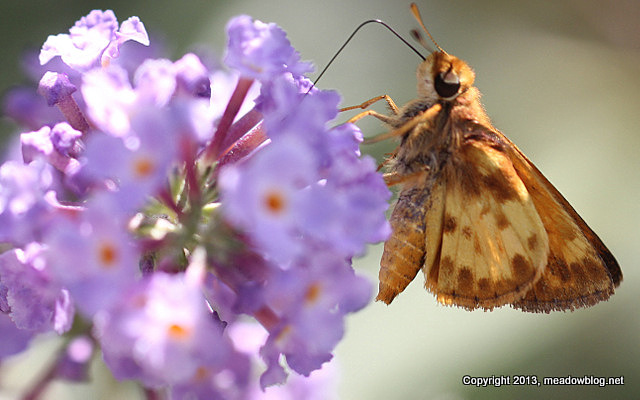
One of those confusing (but beautiful) little skippers we are seeing these days in the Meadowlands is the Zabulon Skipper.
More on Zabs here.

One of those confusing (but beautiful) little skippers we are seeing these days in the Meadowlands is the Zabulon Skipper.
More on Zabs here.
 To see what we might see in the Meadowlands in August, we thought we’d look back to August 2012.
Here are some highlights (click text for link to the post):
Aug. 2: Molting Cicada at Moth Night
Aug. 9: More about that Banded Peregrine
Aug. 10: Clear-winged Moth
Aug. 15: How Now Brown Dow?
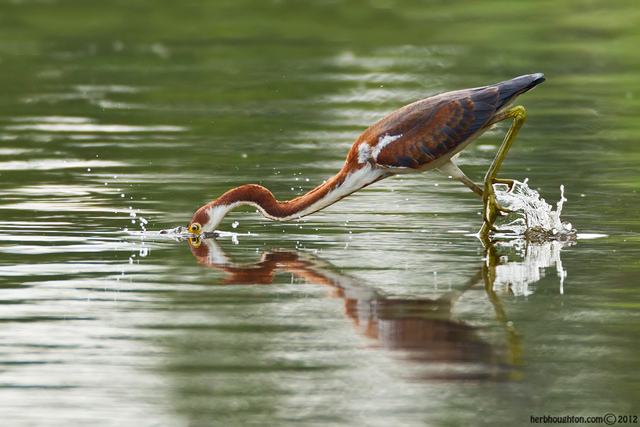
Aug. 16: Tricolored Fishing (above, photo by Herb Houghton)
Aug. 20: Amazing Least Bittern Shots
Aug. 28: Meadowlands Sunset Shots
Aug. 30: Dragonfly Report (Photo by Stephen Buckingham, right)

Don Torino’s latest column for wildnewjersey.tv is all about Mill Creek Point Park in Secaucus.
Here’s a sample.
Just as Mill Creek Point Park, located in Secaucus, is the meeting place of the Hackensack River and the Mill Creek, it is also a wonderful get-together location for Bald Eagles, Black Skimmers, Yellow-Crowned Night Herons, and Peregrine Falcons.
The great riverfront promenade encircled by hundreds of acres of restored wetlands and the adjacent 1,500-foot elevated board walk running from the Mill Creek Point Park to the Secaucus High School makes the birding the restored marshlands to one side and the Hackensack River on the other offer a unique birding experience.
Michael Newhouse, Natural Resources Field Specialist for the NJ Meadowlands Commission, told me: “One of my favorite things about Mill Creek Point Park is the rare high marsh habitat along the high school walkway. High marsh habitat is being lost all along the east coast and its value is indescribable. The walkway allows people to get higher than the marsh and view this beautiful habitat.”
Link is here.
 Get out your binoculars — and send us your Meadowlands Big Year totals as of July 31!
The goal is to see as many different bird species as possible in the 14 towns of the Meadowlands District over the course of 2013 — and also to have fun birding.
To ensure a level playing field, all birds must be seen in areas open to the public, or on guided walks or banding events in such places as Harrier Meadow or the back of the Kingsland Landfill.
The idea is to promote birding in the Meadowlands, and to give area birders a competition that does not require as much travel (and gasoline consumption) as, say, a New Jersey Big Year.
To make this as fair as possible, we have two divisions: Meadowlands residents and non-Meadowlands residents.
More details follow. Continue reading
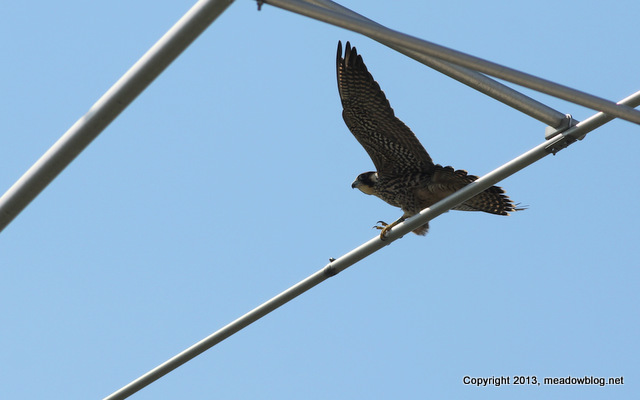
On Monday, we photographed a young banded Peregrine Carlstadt, and set out to find more about it. Christopher A. Nadareski, Section Chief, NYC Environmental Protection, writes:
The tag looks like a 68/AX when I enlarged the photo as the stem of the “X” appears to be angled to the left and not straight like a “Y” but not 100% certain.
If it is a 68/AX then it is the HY [hatch year] male from the Bayonne Bridge nest tower. It was one of two young hatched around May 8, 2013, and I banded on May 29, 2013.
The HY male had a slight case of Frounce, which I treated orally at the nest site. Would like to believe the male survived the Frounce.
Thanks, Chris (with an assist from Kathy Clark of the NJDEP)!
We photographed one of Chris’ banded Peregrines last summer — banded on the MetLife Building in Manhattan. Link is here.
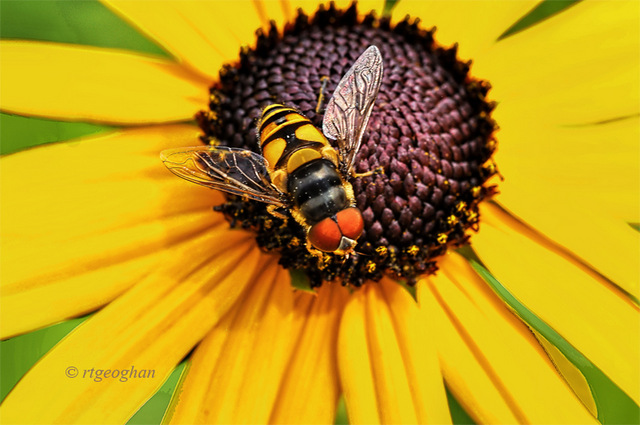
Congrats to Greg Miller for identifying yesterday’s bug on the Tuesday Teaser.
It is a Transverse Flower Fly. (Who knew?) (Thanks, Greg!)
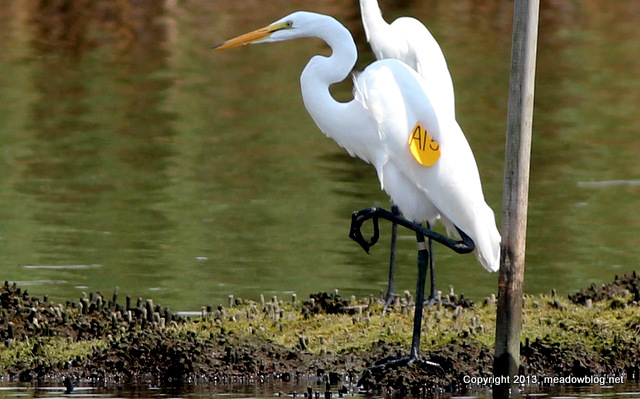 Susan Elbin of NYS Audubon writes:
Birders are once again being asked to be on the lookout for wing-tagged
Great Egrets this summer-autumn. Great Egrets were tagged earlier this
month in Canada and in the New York Harbor.
In Canada, they were tagged at their nesting colony on Georgian Bay, Lake
Huron, near Collingwood, Ontario (100 km NW of Toronto). This year
flightless young birds were marked with light BLUE tags, one on each wing.
The tags are marked with two numbers and a letter, e.g. 28T.
In New York City, birds were tagged in Jamaica Bay with YELLOW tags with
either 2 numbers and a letter, or a letter and 2 numbers (black).
Continue reading

Photographer Regina Geoghan, a frequent contributor to this blog, recently wrote a post for wildnewjersey.tv about photographing butterfluies at DeKorte Park.
Here’s a sample:
“Suddenly, out of the corner of my eye, a bright spot of orange appears and my heart starts to beat a little faster. YES – a butterfly!!! A Monarch? – No – a Viceroy. It lights on the butterfly bush near me and I edge closer and begin my daily dance. As it flits and flutters from one blossom and one plant to the next, I follow back and forth, until it stops long enough and poses for me to snap the shutter – again – and once more to get a photograph of the Viceroy set against the bright blue sky.
“It is, for me, a record of a magical moment of beauty in this day. Soon after, those same bushes are alive with movement as dozens of Skipper butterflies of all sizes and several Clear-winged Moths jostle with each other for a prime flower. Two Black Swallowtails fly in to join the club, and an hour later just as I must leave, an American Lady makes an appearance.”
The entire post is here.
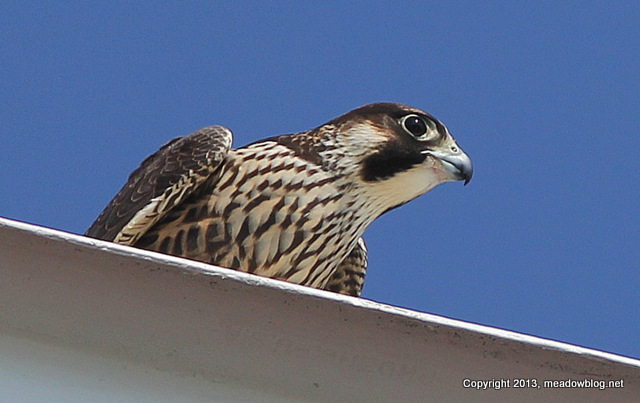
When we were in Carlstadt yesterday checking on an Osprey nest, we also saw hundreds and hundreds of peeps.
We thought, “This would be quite a buffet for a Peregrine Falcon.”
Moments later, two Peregrines arrived, one after the other, and promptly divebombed the peeps (unsuccessfully).
We took several shots, including one that showed a leg band clearly — 68-AY. We are now trying to find out more about this bird. A third Peregrine arrived and flew around for a while as well. Two of the Peregrines, including the banded one and the one pictured above, looked like young birds.
We will let you know what we learn.
Incidentally, we had a banded Peregrine less than a half-mile away in late July 2011. More on that Peregrine (with similar numbers) here and here.
Gallery of Peregrine shots from yesterday, including banding shots, follows. As you’ll see, some were photographed fairly far away and cropped.
(This gallery thing is new — let us know what you think….) Continue reading
What’s this? Photo and teaser courtesy of Regina Geoghan.